
Product Knowledge
What Is UL 2056? A Complete Guide to the Power Bank Safety Standard
What Is UL 2056? A Complete Guide to the Power Bank Safety Standard
Aug 5, 2026
Product Knowledge
What Is UL 2056? A Complete Guide to the Power Bank Safety Standard
Aug 5, 2026
Power banks have become an essential accessory for smartphones, tablets, laptops, and other portable electronic devices. As battery capacity and charging power continue to increase, safety has become an important consideration for brands, importers, retailers, and consumers.
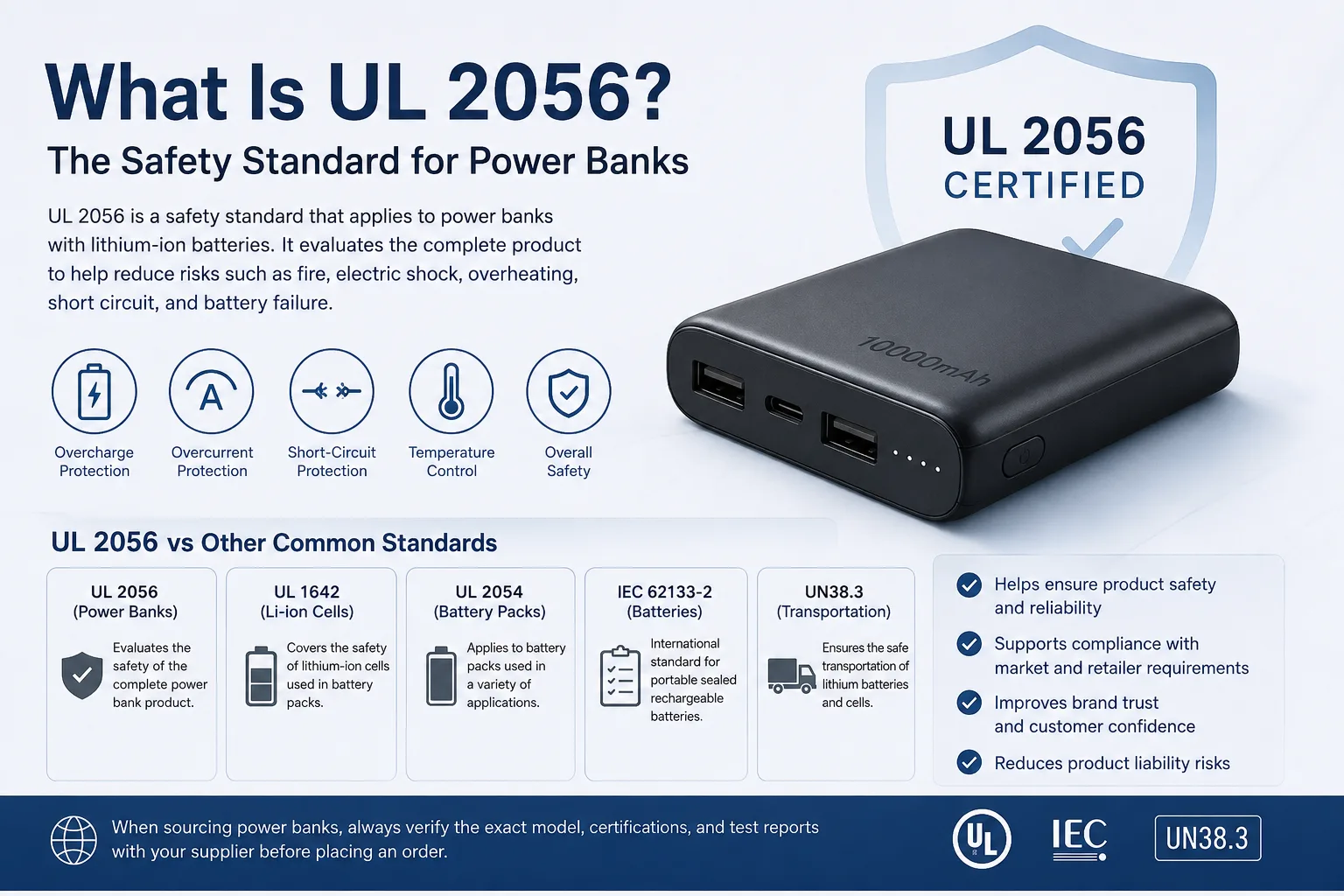
UL 2056 is a safety standard specifically developed for power banks. It evaluates the safety of the complete power bank, including its lithium-ion battery system, charging and discharging circuits, protection mechanisms, enclosure, and overall product construction.
For companies sourcing or selling power banks in the United States, understanding UL 2056 can help reduce product safety risks and make it easier to evaluate potential suppliers.
This guide explains what UL 2056 is, what it covers, how it differs from other battery standards, and what buyers should check before purchasing power banks.
UL 2056 is a safety standard for power banks published by UL Standards & Engagement.
Unlike standards that focus only on lithium-ion cells or battery transportation, UL 2056 evaluates the complete power bank as a finished product.
The standard addresses potential hazards associated with rechargeable power banks, including:
In simple terms:
UL 2056 is designed to evaluate whether a power bank can operate safely under normal use and foreseeable abnormal conditions.
This distinction is important because a power bank is more than just a lithium-ion battery.
A typical power bank contains:
Battery Cells → Battery Pack → BMS/Protection Circuit → Charging Circuit → DC-DC/PD Circuit → USB Input/Output → Enclosure
A safe battery cell alone does not guarantee that the finished power bank is safe. UL 2056 therefore evaluates the complete system.
UL 2056 is primarily intended for standalone rechargeable power banks used to provide portable DC power to electronic devices.
Typical products may include:
For example, a modern 20,000mAh 65W USB-C PD power bank contains significantly more power-management electronics than a traditional 5V USB power bank.
The higher charging and discharging power makes proper thermal management, battery protection, PCB design, component selection, and enclosure design increasingly important.
Buyers should always confirm that the specific product configuration falls within the applicable scope of the current UL 2056 edition.
Lithium-ion batteries store a significant amount of energy in a relatively small enclosure.
When the battery, protection circuit, PCB, connector, enclosure, or charging system is poorly designed, several safety problems may occur.
Lithium-ion cells should not be charged beyond their specified limits.
A properly designed power bank normally uses protection circuitry to stop or control charging when abnormal conditions occur.
UL 2056 evaluates how the finished product responds to relevant charging conditions and potential failures.
USB ports, cables, connectors, PCB components, or external devices can potentially create abnormal electrical conditions.
A safe power bank should have appropriate protection mechanisms to prevent these conditions from causing dangerous overheating or fire.
Modern USB-C PD power banks may support outputs such as:
Higher power levels can create additional thermal-management challenges.
The design therefore needs to consider battery temperature, PCB temperature, power components, internal layout, enclosure materials, and protection mechanisms.
Power banks are portable products and are frequently carried in backpacks, handbags, suitcases, and pockets.
They may experience drops, impacts, vibration, or other mechanical stresses during normal transportation and use.
Safety evaluation therefore cannot focus only on electrical performance.
The battery management and protection system is one of the most important safety components inside a power bank.
Depending on the design, protection may address conditions such as:
UL 2056 considers the finished product and its safeguards rather than relying solely on the specifications of individual battery cells.
The exact evaluation depends on the product construction and the applicable edition of the standard, but UL 2056 addresses several important areas of power bank safety.
These can include evaluation of:
Electrical Safety
The power bank is evaluated under normal and abnormal electrical operating conditions.
Battery Charging and Discharging
The battery system and associated protection mechanisms are evaluated to determine how the product responds to relevant charging and discharging conditions.
Short-Circuit and Abnormal Operation
The product must safely handle specified fault or abnormal conditions without creating unacceptable hazards.
Temperature and Thermal Safety
Temperatures at important components and battery locations are evaluated under specified operating conditions.
Mechanical Safety
The product may be subjected to mechanical tests intended to simulate stresses that portable products can encounter.
Fire and Enclosure Safety
Materials, construction, spacing, and enclosure characteristics may be evaluated to reduce fire and other safety risks.
Because requirements can change between editions of a standard, manufacturers and buyers should use the current applicable version of UL 2056 rather than relying on an old test checklist.
This is one of the most common questions from power bank buyers.
UL 2056 and UN38.3 serve different purposes.
StandardPrimary PurposeMain FocusUL 2056 | Product safety | Finished power bank
UN38.3 | Transportation safety | Lithium battery during transportation
UN38.3 does not replace UL 2056.
UN38.3 is associated with the safe transportation of lithium cells and batteries. It includes tests related to transportation conditions such as altitude, temperature, vibration, shock, external short circuit, impact/crush where applicable, overcharge, and forced discharge.
UL 2056, by contrast, focuses on the safety of the power bank as a finished product.
A power bank can therefore have a valid UN38.3 test report without being UL 2056 certified.
For importers, this distinction is important:
UN38.3 answers a transportation-safety question. UL 2056 addresses finished-product safety.
Another common misunderstanding is that a power bank using UL-certified cells automatically becomes a UL-certified power bank.
That is not the case.
UL 1642 primarily applies to lithium batteries/cells at the component level, while UL 2056 addresses the complete power bank.
For example:
UL 1642 Cell
↓
Battery Pack
↓
BMS / Protection Circuit
↓
USB-C PD PCB
↓
Enclosure
↓
Finished Power Bank
Even if the cells have been evaluated to an applicable UL standard, the finished power bank contains many additional components and potential failure points.
Therefore:
A power bank using UL-recognized or certified cells is not automatically a UL 2056-certified power bank.
Buyers should verify the certification status of the complete model rather than checking only the battery cell.
IEC 62133-2 is another important standard frequently seen in lithium battery documentation.
The main distinction is the scope.
IEC 62133-2 focuses on safety requirements for portable sealed secondary lithium cells and batteries used in portable applications.
UL 2056 is specifically focused on power banks as finished products.
Depending on the market, customer, certification program, and product design, manufacturers may encounter both standards.
They should not automatically be treated as interchangeable.
IEC 62368-1 is a broader product safety standard covering audio/video, information, and communication technology equipment.
Its scope includes many types of electronic equipment and uses a hazard-based safety engineering approach.
UL 2056, on the other hand, is specifically designed for power banks.
Therefore, an IEC 62368-1 or UL 62368-1 report should not automatically be interpreted as equivalent to UL 2056 certification for a power bank.
When a customer specifically requests:
“UL 2056 certified power bank”
the supplier should provide documentation showing that the relevant finished power bank model is covered by the appropriate UL 2056 certification.
This question requires some care.
UL 2056 should not simply be described as a universal federal legal requirement for every power bank sold in the United States.
Product safety requirements can depend on factors such as:
A retailer, distributor, marketplace, or corporate buyer may impose safety requirements that go beyond minimum regulatory obligations.
For this reason, importers should determine the exact compliance requirements for their specific product and sales channel before placing a purchase order.
For high-volume programs, professional compliance advice or consultation with an accredited testing/certification organization is recommended.
Marketplace requirements can change over time and may depend on product classification.
Amazon may request safety and compliance documentation for products containing lithium-ion batteries, including power banks.
Sellers should therefore check the current Amazon Seller Central compliance requirements for the specific ASIN and marketplace rather than assuming that one certificate will satisfy every request.
This is particularly important because:
Amazon compliance requirements ≠ transportation requirements ≠ UL certification requirements.
They may overlap, but they are not the same thing.
TikTok Shop also maintains policies for products containing batteries and potentially hazardous materials.
Requirements can change, so sellers should verify the current TikTok Shop US product compliance and dangerous-goods policies before listing a power bank.
For lithium battery products, transportation documentation such as UN38.3 is particularly important.
However:
Having UN38.3 documentation does not mean that the finished product is UL 2056 certified.
Brands selling across multiple channels should therefore build a compliance file based on the product itself rather than preparing documentation only when a marketplace requests it.
Before importing power banks, buyers should request documentation for the exact model being purchased.
A useful initial checklist includes:
If the supplier claims that the product is UL 2056 certified, request evidence that identifies the applicable product/model.
Do not rely only on a UL logo printed on a specification sheet.
Lithium batteries generally require appropriate UN38.3 documentation for transportation.
Check that the model, battery specifications, manufacturer information, and other relevant details correspond to the actual product.
A Safety Data Sheet may be required by logistics providers, freight forwarders, warehouses, or other parties handling lithium battery shipments.
Request information including:
The specification should clearly identify:
Depending on the product and destination market, additional requirements may apply.
Examples may include EMC, wireless charging, chemical/material, labeling, or environmental compliance requirements.
One of the biggest sourcing mistakes is accepting a supplier's statement that a product is “UL certified” without checking what exactly is certified.
Before ordering, ask:
Which standard?
“UL certified” by itself is not sufficiently specific.
Ask whether the certification relates to:
Then ask:
Which exact model is covered?
The product being purchased should correspond to the model covered by the certification.
Also check:
Who owns the certification?
The certificate holder may be the actual manufacturer, battery supplier, OEM factory, or another company.
Finally, verify certification information using the relevant certification organization's official database whenever possible.
For large orders, certification verification should be completed before mass production, not after the goods are ready to ship.
Importers frequently encounter several problems when sourcing power banks.
False.
Component certification and finished-product certification are different.
False.
UN38.3 primarily addresses lithium battery transportation safety.
Not necessarily.
Differences in battery capacity, PCB, enclosure, charging power, cell configuration, or other components can affect certification coverage.
A certificate should be checked against:
Manufacturer + Model + Product Construction + Standard + Certification Status
This can become extremely expensive.
If the selected battery cell, PCB, enclosure material, or product construction does not meet certification requirements, redesign or retesting may be necessary.
Compliance should therefore be considered during product selection and development.
For private-label and OEM projects, safety compliance should begin during product development.
A typical process is:
Product Requirements
↓
Target Market & Sales Channels
↓
Required Standards
↓
Cell Selection
↓
BMS / PCB Design
↓
Enclosure & Material Selection
↓
Prototype
↓
Safety Testing
↓
Certification
↓
Pilot Production
↓
Mass Production
This approach is generally more efficient than designing the product first and attempting to solve certification issues immediately before shipment.
For example, if a US brand plans to launch a 20,000mAh 100W USB-C PD power bank, the supplier should understand the target compliance requirements before finalizing the battery cells, PCB, USB-C PD controller, thermal design, and enclosure.
UL 2056 is an important safety standard for power banks because it evaluates the complete product rather than only the lithium-ion battery cell.
For brands and importers, the key point is to understand that different compliance documents serve different purposes:
UL 2056 → Power bank product safety
UN38.3 → Lithium battery transportation safety
UL 1642 → Lithium battery/cell safety
IEC 62133-2 → Portable rechargeable cell and battery safety
IEC/UL 62368-1 → AV/ICT equipment safety
The exact compliance package required for a power bank depends on its design, target country, distribution channel, and customer requirements.
Before purchasing or developing a power bank, buyers should verify the actual product model, battery cells, safety documentation, transportation documentation, and certification status.
If you are developing a private-label or OEM power bank for the US market, selecting the right product platform before customization can simplify the compliance process.
We can provide information on available power bank models, battery specifications, USB-C PD configurations, existing compliance documentation, OEM/ODM options, and sample availability.
Contact us to request available UL 2056 power bank models, compliance documents, product specifications, or samples.
Last reviewed: August 2026
Disclaimer: This article provides general information about power bank safety standards and is not legal or regulatory advice. Requirements may vary by product, jurisdiction, certification program, retailer, and marketplace. Always verify current requirements with the relevant authority, certification body, testing laboratory, or sales platform.
UL 2056 is a safety standard specifically developed for power banks. It evaluates the finished product and addresses electrical, battery, thermal, mechanical, and fire-related safety risks.
No. UL 2056 focuses on finished-product safety, while UN38.3 addresses lithium battery transportation safety.
No. They serve different purposes.
No. Certification of a battery cell does not automatically certify the finished power bank.
No. The standards have different scopes. Buyers should verify which standard applies to the specific product and certification requirement.
No. IEC 62133-2 primarily addresses portable rechargeable lithium cells and batteries, while UL 2056 specifically addresses power banks.
It should not be described as universally mandatory for every power bank under all circumstances. Applicable requirements depend on regulations, product configuration, sales channels, retailers, and customer requirements.
Request documentation for the exact model and verify the certification holder, model information, applicable standard, and current certification status through the appropriate official certification database.