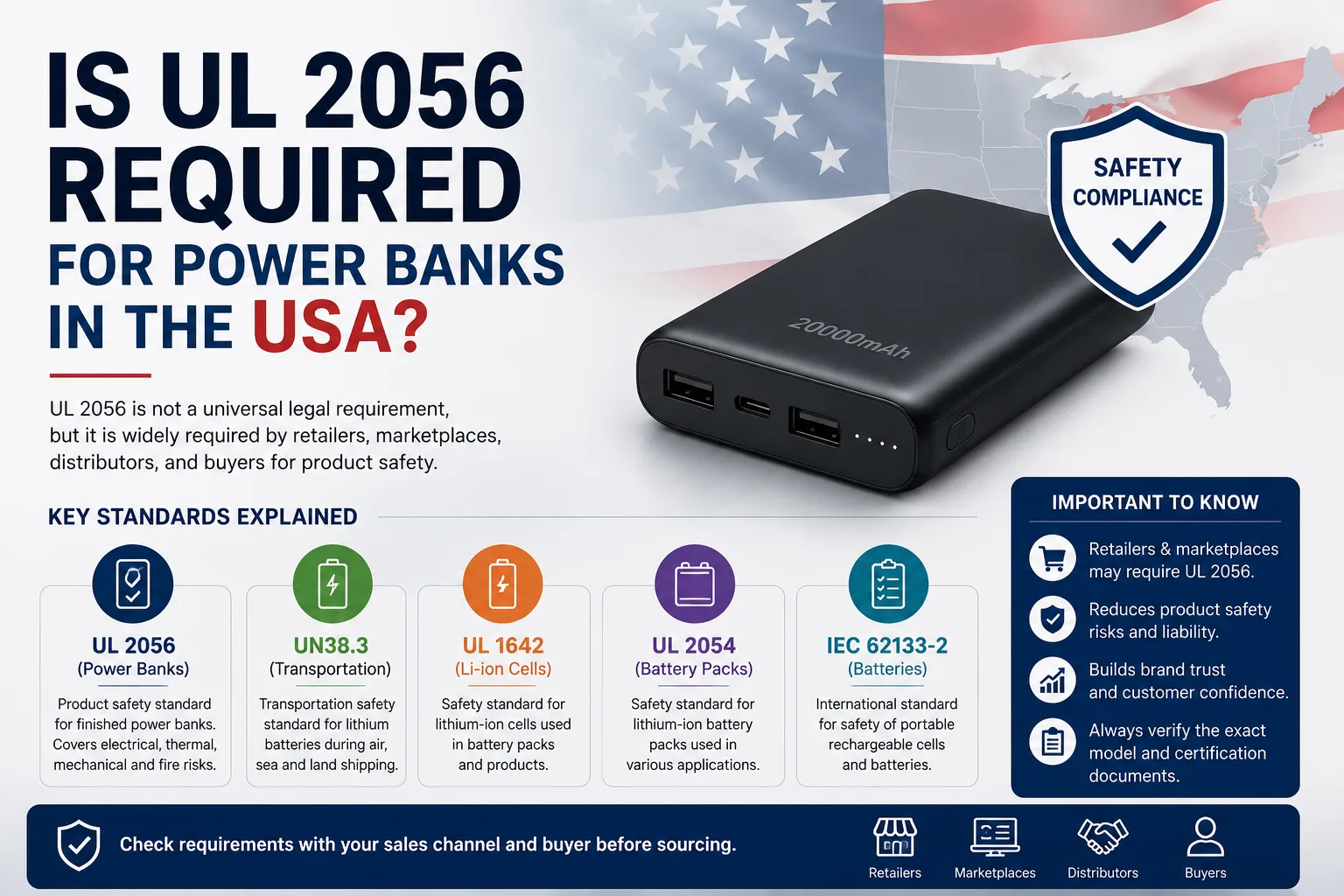
Is UL 2056 Required for Power Banks in the USA?
If you are planning to sell power banks in the United States, sooner or later you will probably come across UL 2056.
A customer may ask for it. A retailer may mention UL certification. A testing lab may recommend it. And if you search online, you will find plenty of conflicting answers about whether UL 2056 is actually required.
So, is UL 2056 mandatory for power banks in the USA?
The short answer is: not universally. UL 2056 is not currently a blanket federal legal requirement for every power bank sold in the United States. However, it is an important power bank safety standard, and in many commercial situations it may be required by retailers, distributors, marketplaces, insurers, or buyers.
That distinction matters, especially for brands and importers sourcing power banks from overseas.
This article explains where UL 2056 fits into the U.S. compliance picture, when you may need it, and what documents you should check before placing a power bank order.
What Is UL 2056?
UL 2056 is a safety standard specifically developed for power banks, also commonly called portable chargers or portable backup battery packs.
The current UL 2056 standard covers standalone power banks used to provide power to low-voltage electronic devices. Its scope includes products with DC outputs up to 60V and power banks with a rated energy of no more than 100Wh. The standard is intended to reduce the risk of fire or explosion.
This means UL 2056 looks at the power bank as a finished product, rather than evaluating only the lithium-ion cell inside it.
A typical modern power bank includes much more than a battery:
Lithium-ion cells → Battery protection/BMS → Power management circuit → USB-C PD controller → Input/output ports → Enclosure
A problem with any one of these elements can affect the safety of the finished product.
That is why using a certified battery cell does not automatically make the complete power bank UL 2056 certified.
Is UL 2056 Legally Mandatory in the United States?
For most ordinary consumer power banks, UL 2056 should not be described as a universal federal mandatory certification.
The U.S. Consumer Product Safety Commission lists UL 2056 among the voluntary safety standards associated with battery products. CPSC's battery standards information distinguishes these voluntary standards from mandatory federal product safety rules.
This is an important point.
A statement such as:
“Every power bank sold in the United States is legally required to have UL 2056.”
would be too broad.
But the opposite statement—
“UL 2056 is voluntary, so we don't need to worry about it.”
—is also a poor way to look at U.S. product compliance.
There is a large difference between not universally mandated by federal law and not commercially important.
For an importer or brand, the real question is usually not:
“Does the federal government force me to have UL 2056?”
It is:
“What safety documentation will I need to sell this product through my intended channel, and what level of safety evidence am I comfortable putting behind my brand?”
Why UL 2056 Still Matters
Power banks combine lithium-ion batteries with charging electronics in a small portable enclosure.
When something goes wrong, the consequences can be serious.
CPSC has repeatedly recalled or warned about power banks because of overheating, fire, explosion, and burn hazards.
For example, in 2025 CPSC warned consumers about approximately 93,000 Yiisonger power banks after receiving 79 reports involving exploding, igniting, or swelling batteries. One reported fire caused approximately $15 million in property damage.
In another case, CPSC recalled wireless portable power banks because the lithium-ion batteries could overheat and ignite.
And in April 2026, CPSC reannounced a recall covering approximately 429,200 Casely power banks following fire and burn concerns.
These cases are useful reminders that power bank compliance is not only a paperwork issue.
For an importer, a battery safety failure can lead to:
- Product recalls
- Customer injuries
- Inventory loss
- Marketplace suspension
- Retailer claims
- Product liability exposure
- Brand damage
The cost difference between two power banks may be only a few dollars.
The cost difference after a serious battery incident can be much larger.
When Might UL 2056 Be Required in Practice?
Even when a standard is voluntary at the federal level, commercial partners can make compliance with that standard part of doing business.
There are several situations where UL 2056 becomes much more relevant.
Retailer Requirements
Large retailers often have their own product safety programs.
A retailer can require safety certification or laboratory testing before accepting a product, even if that exact certification is not explicitly mandated by federal law.
If you plan to sell through major U.S. retail channels, it is worth asking about their battery safety requirements before selecting the product.
Trying to solve the certification issue after production is usually more expensive.
Distributor or Corporate Buyer Requirements
B2B buyers sometimes write UL requirements directly into their purchasing specifications.
For example, an RFQ may state:
Power bank must be UL certified.
The first thing you should clarify is which UL standard they mean.
A supplier saying “our battery has UL” is not necessarily answering the question.
The customer may specifically require:
UL 2056 certification for the finished power bank.
If that is the requirement, a UL 1642 certificate for the cell or another battery document will not automatically satisfy it.
Insurance and Product Liability Considerations
Safety certification can also matter outside the direct regulatory process.
Importers, distributors and product liability insurers may consider recognized safety standards when assessing risk.
This becomes more important as products increase in capacity and output power.
A simple 5,000mAh power bank and a 20,000mAh 100W USB-C PD power bank are both called “power banks,” but from an engineering perspective they are not equally demanding products.
Higher-power products place greater demands on:
- Battery cells
- MOSFETs
- PCB design
- USB-C PD controllers
- Connectors
- Thermal management
- Protection circuits
For brands purchasing high-output power banks, independent product safety evaluation deserves more attention.
Does Amazon Require UL 2056?
This question is more complicated than it looks.
Amazon's compliance requirements can depend on the product, ASIN, marketplace, battery configuration, fulfillment method and current platform policies.
It is therefore risky to make a permanent statement such as:
“Amazon always requires UL 2056.”
or:
“Amazon never requires UL 2056.”
Marketplace requirements change.
Amazon may request battery-related safety and compliance documentation, and products can also become subject to additional compliance review.
The safer approach for a seller is to verify the current requirements in Seller Central for the exact product being listed.
From a sourcing perspective, it is also useful to keep the following documents organized before launching:
- Product specification
- Battery cell information
- UN38.3 documentation
- SDS
- Applicable safety test reports
- Applicable UL documentation
- Model identification
- Manufacturer information
Having these documents ready is considerably easier than trying to collect them from a factory after a compliance request arrives.
Is UN38.3 Enough for Selling Power Banks in the USA?
No.
This is probably the most common misunderstanding we see when buyers review power bank documents.
A supplier sends a UN38.3 report and says:
“The battery is certified.”
But UN38.3 and UL 2056 deal with different risks.
Document / StandardMain PurposeUL 2056 | Finished power bank safety
UN38.3 | Lithium battery transportation
UL 1642 | Lithium cell/battery safety
UL 2054 | Battery pack safety
IEC 62133-2 | Portable rechargeable cell/battery safety
UN38.3 is primarily concerned with whether lithium batteries have passed the required tests for transportation.
UL 2056 looks at the safety of the finished power bank.
So a power bank can have:
UN38.3: Yes
but:
UL 2056: No
There is nothing unusual about that.
The mistake is treating the two documents as interchangeable.
What About a Power Bank With UL 1642 Cells?
This is another situation worth checking carefully.
Suppose a supplier tells you:
“We use UL-certified cells.”
That is positive information, but it does not mean the complete power bank has been certified to UL 2056.
Think about the product in layers.
The cell may be safe.
But the finished product still contains:
- Cell connections
- Protection PCB
- Charging circuit
- Boost/buck circuit
- USB-C controller
- Temperature sensing
- Wiring
- Connectors
- Housing materials
UL 2056 is concerned with the complete product.
From a purchasing perspective, always ask:
Is this exact finished model covered by the UL 2056 certification?
That is much more useful than asking:
“Does it have UL?”
What Should an Importer Ask a Power Bank Supplier?
If we were reviewing a power bank for a U.S. customer, we would not start with a long list of certification acronyms.
We would start with the actual product.
First, confirm the exact model.
Then ask for:
- Battery capacity in mAh
- Rated energy in Wh
- Cell manufacturer and model
- Cell configuration
- Input specifications
- Output specifications
- Maximum USB-C PD output
- Protection functions
- Existing safety certifications
- UN38.3 test summary
- SDS
- Relevant test reports
If the factory claims UL 2056 certification, request documentation for the exact product model.
Do not assume that:
- another capacity is covered;
- another PCB version is covered;
- another enclosure is covered;
- a similar-looking model is covered.
For OEM projects, this becomes especially important.
Changing the battery cell, housing material, PCB, capacity, connector configuration or other critical components may affect certification.
Can You Put Your Own Brand on a UL 2056 Power Bank?
Usually this needs to be reviewed case by case.
Many importers find an existing certified power bank and want to add:
- Their logo
- Custom packaging
- Custom color
- Different model number
- Different cable
- Different battery capacity
Some changes may be relatively straightforward.
Others may affect the certification.
A common sourcing mistake is assuming:
“The factory has one UL 2056 model, so every OEM version is automatically covered.”
That should never be assumed.
Before changing a certified product, confirm with the manufacturer and certification body whether the proposed OEM/private-label configuration remains within the certification scope.
UL 2056 Is More Relevant as Power Banks Become More Powerful
The power bank market has changed quickly.
A few years ago, many mainstream power banks were simple 5V USB chargers.
Today, it is common to see:
- 20W
- 30W
- 45W
- 65W
- 100W
- 140W USB-C power banks
Many are designed to charge laptops as well as phones.
Higher charging power makes the electronics more demanding, while consumers still expect the product to remain small and lightweight.
This creates an engineering trade-off.
The manufacturer needs to manage:
Power density + Heat + Battery safety + Size + Cost
Reducing cost too aggressively can affect cells, components, thermal design and protection architecture.
That is one reason serious buyers increasingly look beyond capacity and price when selecting a power bank.
What About Power Banks Over 100Wh?
This is another detail buyers should notice.
The current UL 2056 scope covers power banks with a watt-hour rating not exceeding 100Wh.
That includes many familiar products such as:
- 10,000mAh power banks
- 20,000mAh power banks
- Many approximately 24,000–27,000mAh models
But very large battery products may fall outside the UL 2056 scope.
If you are developing a large-capacity portable battery product, do not assume UL 2056 automatically applies simply because the supplier calls the product a “power bank.”
The product architecture and applicable standard need to be reviewed.
So, Should You Choose a UL 2056 Power Bank?
If you are sourcing a low-cost promotional power bank for a market where the customer has no UL requirement, your compliance strategy may differ from that of a major U.S. brand launching a 100W laptop power bank.
There is no single answer for every project.
But for buyers targeting the U.S. market, especially those selling through established retail channels or building their own brand, choosing a product platform that has already gone through recognized safety evaluation can reduce uncertainty.
A useful way to make the decision is to ask four questions:
1. What does my sales channel require?
Check retailer, marketplace and distributor requirements.
2. What does my customer require?
If the customer specifically requests UL 2056, do not substitute another certificate without approval.
3. What is the risk level of the product?
Capacity, charging power, battery chemistry and application all matter.
4. How long will I sell this product?
For a long-term branded product, investing in a strong compliance foundation usually makes more sense than solving each certification issue after launch.
Frequently Asked Questions
Is UL 2056 mandatory for all power banks sold in the USA?
No. UL 2056 is not currently a universal federal mandatory certification for every power bank sold in the United States. However, retailers, marketplaces, distributors, insurers or customers may require UL-related safety documentation.
What does UL 2056 cover?
UL 2056 covers standalone power banks and addresses safety risks including fire and explosion. The current scope includes products with output up to 60V DC and rated energy up to 100Wh.
Is UN38.3 the same as UL 2056?
No. UN38.3 relates primarily to lithium battery transportation, while UL 2056 evaluates the finished power bank.
Does a UL 1642 cell make a power bank UL certified?
No. Certification of the lithium cell does not automatically certify the complete power bank.
Can I sell a power bank in the USA without UL 2056?
Potentially yes, depending on the product and sales channel. But you still need to determine all applicable U.S. safety, transportation, marketplace and customer requirements.
Should an OEM power bank have UL 2056?
If your customer, retailer or distribution channel requires it, yes. Even when it is not specifically required, UL 2056 can be valuable for brands that want additional finished-product safety assurance.
How do I verify a supplier's UL 2056 certification?
Ask for the certification information for the exact model and verify the model, manufacturer/certificate holder, applicable standard and certification status through the relevant official certification database.
Final Takeaway
So, is UL 2056 required for power banks in the USA?
Not as a universal federal requirement for every power bank.
But that does not make it irrelevant.
UL 2056 exists because power banks present real battery, electrical and thermal risks. Recent U.S. recalls continue to show that overheating and battery fires remain a practical concern, not just a theoretical one.
For importers and brands, the sensible approach is to evaluate compliance at the beginning of the sourcing process.
Before placing an order, confirm:
What are you selling?
Where are you selling it?
What does your customer or platform require?
And what exactly has the supplier tested and certified?
Those four questions are usually more useful than simply asking whether a power bank “has UL.”
Looking for Power Banks for the U.S. Market?
If you are sourcing an OEM or private-label power bank for the United States, we can provide information on available models, battery specifications, USB-C PD configurations, existing test reports and certification documentation.
For projects requiring UL 2056, tell us your target capacity, output power, sales channel and expected quantity. We can help you identify suitable existing product platforms before you invest in samples, packaging or mass production.
Request available power bank models and compliance documents.